Submitted by pbartlett on
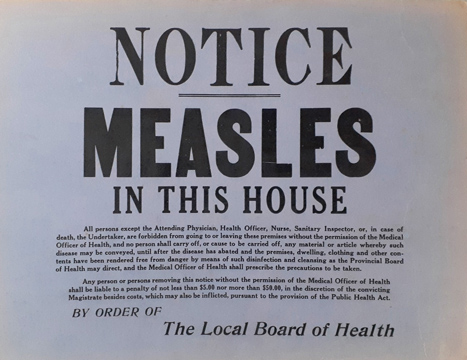
Measles on the Rise
In May of 1950, sixty members of the Tavistock Teen Towners gathered to honour Carl and Ann Seltzer, their mentors, on the occasion of their recent marriage. Speeches were made, songs were sung, gifts were presented, dancing followed. All in all it was a wonderful evening. Unfortunately…Mrs. Seltzer, the star of the show, was unable to attend the party as she had come down with measles two hours earlier.
Measles was once an inevitable fact of life in Tavistock. Every three to five years an epidemic would sweep through the village affecting primarily infants and children not previously exposed. Invariably the primary grades at the Tavistock Public School would be shut down for weeks at a time and playoff hockey games would have to be cancelled.
Measles was so wide-spread that many believed it was a normal and harmless part of childhood. But in reality, measles annually killed more children than polio, a disease that struck parents with terror. The Morgenroth family had the sad misfortune in 1921 to lose one of their small twin daughters. “With startling suddenness,” the Tavistock Gazette reported, “the little child contracted measles. Within 24 hours, the little one was no more.” In 1924, Esther Loretta Hammer, aged 12 years, 10 months and five days, “contracted measles during the mild epidemic in the village and developed complications which proved fatal.”
Even adults were not without risk. In 1916, “Menno Lichti, one of the youngest agriculturists in East Zorra, died age 35 years. He had been ailing for two weeks, having contracted the measles which proved fatal. He leaves his widow, Mary Roth.”
The Tavistock Gazette would often print the number of deaths in the province each month from various communicable diseases. In February 1903, there were 4 deaths in the province from Smallpox (compared to 0 the year before); Scarlet fever 104 (88); Diphtheria 27 (34); Measles 7 (21); Whooping cough 7 (16); Typhoid 19 (25); and Tuberculosis 160 (177).
In order to limit the spread of these diseases, the Provincial government in 1912 passed a regulation that “all cases of measles, whooping cough, mumps, and scarlet fever must be quarantined. Physicians and nurses must report all cases. Houses must be placarded and children kept at home. This is a new regulation. Any official not carrying out these regulations is liable to a fine of $25.”
Elizabeth Halliday recently donated to TDHS a number of these placards that had been in the possession of her husband, the late Dr. Bruce Halliday. There are placards for red measles, chicken pox, smallpox, diphtheria and whooping cough.
In 1967 a measles vaccine became universally available and parents jumped at the opportunity to vaccinate their children. Any parent who had seen their small child suffer even for a few days with persistent fever of 105 degrees, hacking cough and delirium would not hesitate to vaccinate as long as it could be done safely.
The School Pupils Act of 1982 required all pupils to be immunized against diphtheria, tetanus, polio, measles, rubella and mumps. As reported in the Tavistock Gazette in 1984, “Exemptions were allowed on medical and religious grounds. In Perth County, the records of almost 14,000 school children have been checked. 99.8 percent of children are now immunized: 23 pupils (0.2 percent) have a religious exemption and four (0.03 percent) have a medical exemption.”
By 1996 however those numbers were starting to slip. Oxford County had a higher percentage of religious/philosophical exemptions to immunization than the provincial average (2.2% in Oxford; 0.2% in Ontario). Philosophical exemptions to measles vaccine stood at 2.9% in Oxford County.
Though measles had been declared “eliminated” in Canada in 1998, in 2025, after 27 years, Canada lost its measles elimination status. A measles outbreak that had begun in 2024 continued to spread in parts of the country, primarily due to lowered childhood vaccination rates.
Worldwide over the past 50 years, the measles vaccine is estimated to have saved nearly 94 million lives. Dr. Henbest, a graduate of the University of Western Ontario, spoke to a local group in 1985 of his four years spent in rural South Africa. He saw cases there of measles, cholera, tuberculosis, and malaria. He said “it was like practicing medicine of one hundred years ago.” Let us hope that we are not moving in that direction again.
