Submitted by pbartlett on
Exploring Tavistock’s History One Photo at a Time
In March of 2025, Tim Mosher submitted to the Wilmot-Tavistock Gazette the first in a series of photo-articles he did about the Lemp Studio Collection. These articles have now been added to the Tavistock and District Historical Society’s website and can be found under the “Vintage Views” tab on the website’s Home Page.
The Lemp Studio Collection consists of almost 4,000 pictures taken by pharmacist John Lemp and his predecessors between 1878 and the mid-1950s. They’re mostly of Tavistock and the surrounding villages with a few from Northern Ontario. The glass plate images had lain undisturbed in the Lemp Drug Store for more than 70 years until they came to the attention of Robert Gladding and his son, Bill. They were cleaned, sorted and scanned by Bill, Tim and Roy Erb and subsequently found a home with the TDHS.
As a former press photographer, collector of antique photographica and longtime high school photo teacher, Tim recognized that a large number of the pictures were of very high quality both technically and creatively. “Most of these images have never been published before,” he wrote, “but some are worthy of being seen again.”
In each of his articles, Tim took a photograph from the Lemp Studio Collection and looked at it in detail as you would with a great work of art. He would write about the camera that was used to take the image and how the photographer would set the scene. He would explain the process of how the glass plates were developed and what chemicals were used. He would describe lighting techniques and camera settings for exposure and depth of field. He would also point out the information you could glean from a close inspection of the photograph, including the date or time of year it was taken, the occupation of the sitter, the style of clothes worn, the significance and interesting details of the event, and much more.
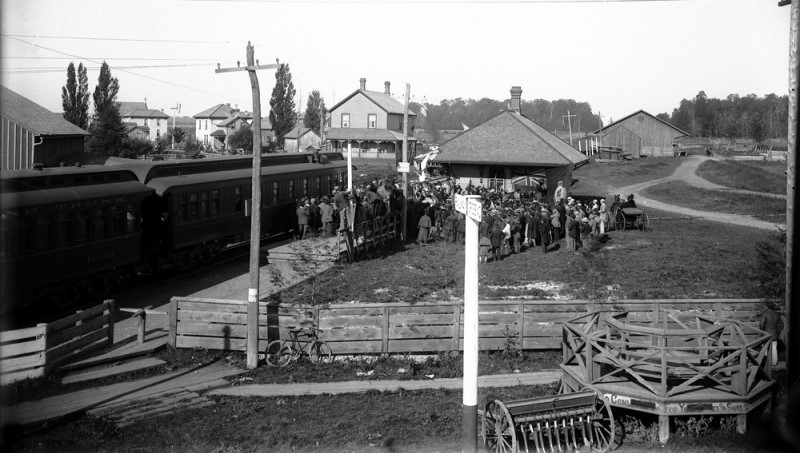
In one of his articles, for example, Tim used the photograph taken by Adrian Murray of the whistle-stop visit of Governor General John Hamilton-Gordon and his wife Lady Aberdeen to Tavistock on September 24, 1896. The photo, Tim determined, must have been taken from the west-facing upper balcony of the Bauer Hotel across Woodstock Street from the train station. There is “good exposure, excellent contrast, sharp and packed with interesting details but the focal length was a little short so it created a distant view.” Tim pointed out among other things a man in a top hat presumed to be the Governor-General, a seeding machine beside the bandstand with advertising on it, a woman on the porch shading her eyes from the sun. And then, using the contemporary report in the Tavistock Gazette, Tim offered the interesting detail that Lord Aberdeen, a Scot, “addressed the crowd in his own language” and Lady Aberdeen spoke in the “purest German.”
At the conclusion of each article, Tim closes with a quiz to the readers. The first person to answer correctly has their name printed in the next article. He asked, for example, why would there be wires and poles in the 1896 photograph of the vice-regal visit if electricity did not reach Tavistock until 1911? The answer can be found in the “Vintage Views” section of the website.
Tim Mosher said on introducing his series that “Now, almost 50 years after sorting the negatives, I’m just as excited to work with this archaic medium as I was as a college photo student.” Each photograph is “a brief moment in time, captured, that will outlive us all, thanks to photography.”
